
Repo Dive
A daily training system for reading production code
In short: Repo Dive is an in-house DanixSoft product (EdTech / Developer Tools): A daily training system for reading production code. Daniyal Alam built it — product decisions, architecture and code. Live at repo-dive.danixsoft.com.
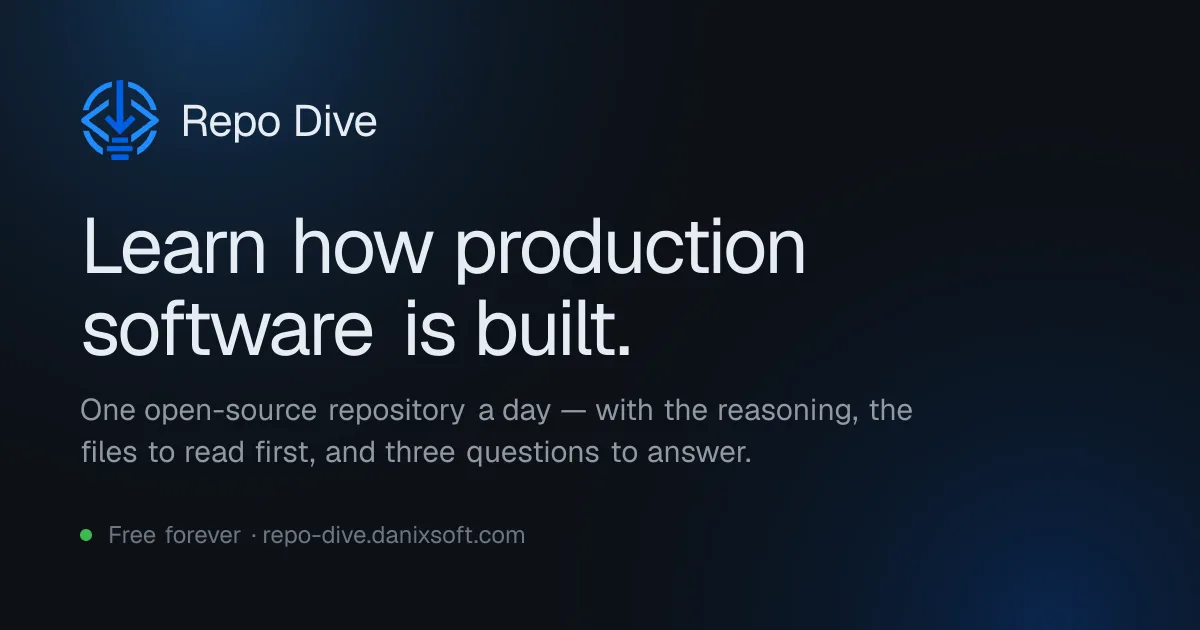
Repo Dive recommends one open-source repository a day, matched to what a developer wants to learn and what they have already read — with a written reason, one thing to focus on, the files to open in order, and three questions to answer afterwards.
- Industry
- EdTech / Developer Tools
- Scope
- Products we build and run in-house at DanixSoft
- Core stack
- Next.js 16 · React 19 · TypeScript · Supabase
- Year
- 2026
The problem
Developers who want to learn from real-world code have no structured way to do it, and an early version picked repositories at random — so nothing already studied changed what came next.
The solution
A deterministic eight-signal ranking model (relevance, novelty, health, readability, documentation, diversity, maturity, difficulty fit) chooses each dive. No language model is involved, so every pick explains itself and regressions show up in tests.
My role
I built it: the commit history of its repository is mine — product decisions, architecture and code.
DanixSoft team
An in-house DanixSoft product — built and operated by the studio, not for a client.
Technical challenges
The engineering problems this build had to get right.
- Idempotent daily jobs under at-least-once cron delivery
- GitHub tokens encrypted with AES-256-GCM in a table no client role can read
- Column-level grants on top of RLS so users can’t write server-owned fields
Architecture
Implementation — what shipped
Engineering notes
Lesson for similar EdTech builds: design for idempotent daily jobs under at-least-once cron delivery and gitHub tokens encrypted with AES-256-GCM in a table no client role can read up front — these are the parts that are expensive to retrofit once the feature list grows.
Technologies
- Next.js 16
- React 19
- TypeScript
- Supabase
- PostgreSQL
- Octokit
- Resend
- GitHub Actions
Building something similar?
A 30-minute discovery call is enough to scope the approach and a realistic budget.